AI Policy
A Declaration of Intellectual Independence
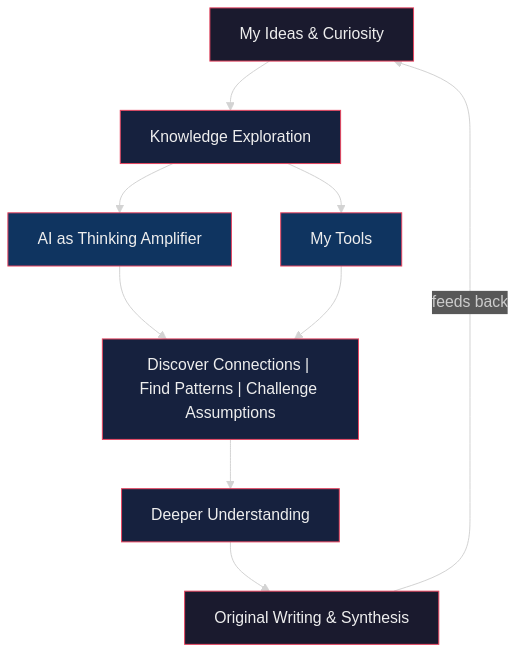
I have been a builder of knowledge tools long before AI entered the conversation. From testing every application, to writing my own, like learn.magj.dev or blogmarks.dev, my work has always orbited the same obsession: how do we explore knowledge faster, connect ideas deeper, and make learning stick? These tools were born from curiosity and friction — from the belief that the right system can turn scattered notes into genuine understanding.
AI did not start this journey. It accelerated it.
I use AI as a bicycle for the mind — a term Steve Jobs used to describe what computers do for human thought. The key insight of that metaphor is that you still have to pedal. A bicycle amplifies your effort; it does not replace your legs. That is exactly how I treat AI: as an amplifier for the thinking I am already doing, never as a substitute for the thinking itself.
What I Believe
Every idea on this site is mine. Every opinion, every synthesis, every connection between concepts — that comes from years of reading, building, failing, and learning again. AI helps me explore the territory faster, but I am the one drawing the map.
I stand with those who see AI as a tool for cognitive transformation, not cognitive outsourcing. Shan Carter and Michael Nielsen drew this distinction brilliantly: a calculator outsources arithmetic, but a spreadsheet transforms how you reason about data. I am not looking for calculators. I am building spreadsheets for thought.
How I Use AI
I use AI tools — deliberately without naming vendors, because principles outlast products — in specific ways that serve my learning:
- Exploring adjacent knowledge. When I study a topic, AI helps me find related concepts I would not have encountered on my own. It widens the search radius of my curiosity.
- Challenging my understanding. I use AI as a sparring partner — testing whether I can explain an idea clearly, or whether my mental model has gaps.
- Building knowledge tools. AI accelerates the development of the exploration infrastructure I have been creating for years. It helps me write code faster, but the architecture and the vision are mine.
What AI never does: it never writes my opinions. It never decides what matters. It never replaces the struggle of learning something hard, because — as the research shows — cognitive muscles, like physical ones, develop through resistance, not assistance.
My Commitments
- I will never let AI speak for me. If text on this site expresses an opinion, it is mine.
- I will never let AI think for me. The synthesis, the judgment, the original connections — those are the whole point.
- I will use AI as a partner, not as an oracle that ends the exploration. Curiosity is the engine. AI is fuel, not the destination.
- I will keep building. The tools at magj.dev exist because I believe we can learn better with better systems. AI is the latest material I am building with — not the architect.
- This page will evolve. Technology changes. My practices will adapt. My values will not.
The Point
Justin Bailey put it sharply: “The writing part is no longer the hard part. The thinking part is.” I agree. And I choose the hard part. I choose to be the architect, not just the carpenter. I choose the bicycle, not the self-driving car.
Everything here is built on a simple conviction: the ideas are mine, and AI helps me find more of the world to think about.
References & Further Reading
| # | Source | Year |
|---|---|---|
| 1 | Dr. Katharina Grimm — How I Use AI in My Job | 2024 |
| 2 | Shan Carter & Michael Nielsen — Using AI to Augment Human Intelligence | 2017 |
| 3 | Daniel Roe — AI Policy and Using AI in Open Source | 2024 |
| 4 | Simon Willison — My Current Policy on AI Writing | 2026 |
| 5 | Justin Bailey — How to Use AI for Writing and Not Cheat | 2024 |
| 6 | Christopher Stappert et al. — The AI Manifesto for Developers | 2024 |
| 7 | Damola Morenikeji — The /ai Manifesto | 2024 |
| 8 | Jason Lodge — Generative AI Is the E-Bike of the Mind | 2025 |
| 9 | Ethan Mollick — Co-Intelligence: Living and Working with AI (Portfolio/Penguin) | 2024 |
| 10 | Douglas Engelbart — Augmenting Human Intellect: A Conceptual Framework (SRI) | 1962 |